
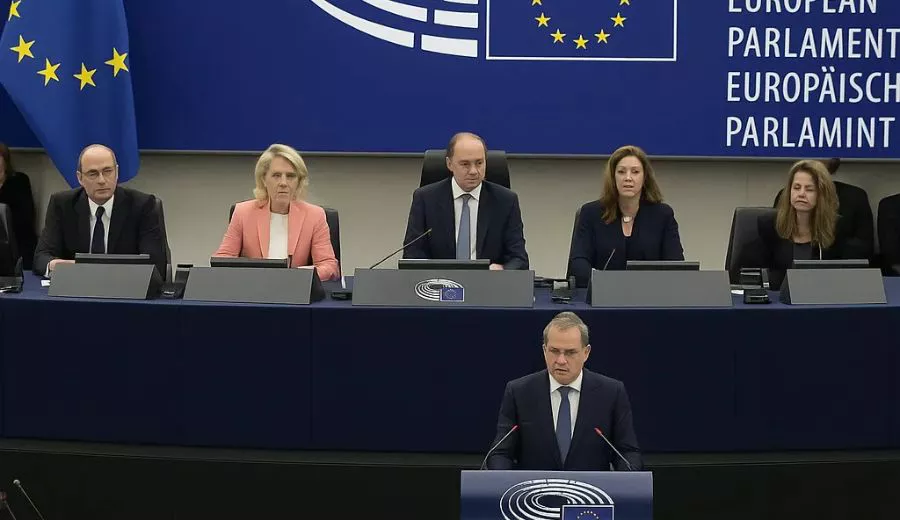
The European Parliament has formally adopted the implementing rules of the Crypto Asset Markets Act (MiCA), establishing the world's first comprehensive regulatory system covering cryptocurrencies, stablecoins, exchanges, and custodians. The new regulations lay the institutional foundation for digital finance in Europe, marking the beginning of a "rule-based era" for the global crypto market. The European Parliament formally adopted the implementation rules for the Crypto Asset Markets Act (MiCA) | The world's most systematic crypto regulatory framework is now in place.
In November 2025, the European Parliament formally adopted the final implementing rules of the Markets in Crypto-Assets Regulation (MiCA) in Brussels. This marks the official launch of the world's first comprehensive regulatory system covering cryptocurrencies, stablecoins, trading platforms, and custody institutions. The adoption of MiCA has not only reshaped the European digital asset market, but will also provide a template for global regulation. European Commission Vice-President Valdis Dombrovskis stated at a press conference: "The future of digital finance requires rules, and MiCA's goal is to find a balance between protecting innovation and maintaining financial stability."
The legislative process for MiCA can be described as "the longest negotiation in regulatory history". Since the European Commission first proposed the digital finance strategy in 2019, MiCA has undergone five years, three draft revisions, and hundreds of hearings. The main controversy centers on:
MiCA's architecture is described as an extension of the Financial Markets Instructions II (MiFID II) in the crypto space, and it primarily comprises four core pillars:
MiCA's greatest innovation lies in its institutional integration: Regardless of which EU member state a company is registered in, it can operate throughout Europe after obtaining a CASP license. This is known as the "EU Passporting" system, similar to a unified passport for the banking industry. However, at the same time, the cost of corporate compliance has also increased significantly.
The implementation of MiCA will completely end the era of "regulatory vacuum". In the past, most cryptocurrency trading platforms operated in the EU as registered entities, rather than as financial institutions. Under the new regulations, all trading platforms must complete their license applications within 18 months, or they will be prohibited from providing services to the public in the EU. Major exchanges such as Binance, Kraken, Bitstamp, and OKX Europe have all initiated compliance review procedures. In particular, stablecoin trading pairs will be subject to strict restrictions, and non-compliant stablecoins may be delisted. Industry insiders predict a round of regulatory reshuffling will occur in early 2026: Only trading platforms with compliance audits, proof of reserves, and local registration can remain in the European market.
MiCA's impact on the stablecoin market can be described as "system-level". In the future, stablecoins circulating in the EU must be authorized, and their issuance and reserve mechanisms will be directly supervised by the European Central Bank.
The final version of MiCA has chosen not to directly include NFT and decentralized finance (DeFi) projects. However, the document clearly states: "If an NFT has divisibility or financial attributes, it should be regarded as a security-type crypto asset and subject to joint regulation by MiFID and MiCA." Meanwhile, the European Commission plans to assess the feasibility of DeFi regulation in 2026. This means that EU regulators have left room for future interfaces.
The European financial community generally welcomed MiCA. The Frankfurt Financial Centre issued a statement saying, "MiCA establishes a legal status for digital assets, which will attract institutional investors back to the European market." At the same time, several crypto companies have expressed concerns:
The passage of MiCA has triggered a global regulatory response. Countries such as the United States, the United Kingdom, Japan, Singapore, and Australia are all studying the development of local standards with reference to the MiCA framework. In particular, some provisions of the U.S. Congress’s Digital Asset Market Structure Act (DAMS) have similar logic to MiCA. The International Monetary Fund (IMF) commented: "Europe has transformed from a passive defender to a regulatory leader, and MiCA may become the common language of global crypto compliance." This will give the EU strategic leadership in digital finance governance.
The implementation of MiCA marks Europe's entry into a new phase where regulation and innovation coexist. It is both a constraint and an opportunity:
BrokerHivex is a financial media platform that displays information from the public internet or user-uploaded content. BrokerHivex does not support any trading platform or instrument. We are not responsible for any trading disputes or losses arising from the use of this information. Please note that the information displayed on the platform may be delayed, and users should independently verify its accuracy.

EU Parliament Adopts Final MiCA Rules | World's Most Comprehensive Crypto Framework Now in Place

Japan's FSA Approves First Bank-Issued Stablecoin | Traditional Finance Officially Enters the Digital Currency Era

Bitcoin ETF Institutional Holdings Hit ATH | TradFi Goes All-In on Crypto

Stablecoins Take Over Global Payments | How the “Digital Dollar” Is Reshaping the World Monetary Order

SEC Considering Major Relaxation of Crypto Custody & Disclosure Rules | U.S. Regulation Shifts from Restriction to Institutional Guidance

HKMA & MAS Jointly Launch Cross-Border Stablecoin Clearing Pilot | Asia’s First Regulated Digital Currency Interoperability Network Officially Starts

You are visiting the FXKNOWS website. FXKNOWS Internet and its mobile products are an enterprise information searching tool for global users. When using FXKNOWS products, users should
consciously abide by the relevant laws and regulations of the country and region where they are located.
License or other information error corrections, please send the information to:info@FXKNOWS.com
Cooperation:info@FXKNOWS.com


The Database of FXKNOWS comes from the official regulatory authorities , such as the FCA, ASIC, etc. The published content is also based on fairness, objectivity and fact. FXKNOWS doesn't ask for PR fees, advertising fees, ranking fees, data cleaning fees and other illogical fees. FXKNOWS will do its utmost to maintain the consistency and synchronization of database with authoritative data sources such as regulatory authorities, but does not guarantee the data to be up to date consistently.
Given the complexity of forex industry, some brokers are issued legal licenses by cheating regulation institutes. If the data published by FXKNOWS are not in accordance with the fact, please click 'Complaints 'and 'Correction' to inform us. We will check immediately and release the results.
Foreign exchange, precious metals and over-the-counter (OTC) contracts are leveraged products, which have high risks and may lead to losses of your investment principal. Please invest rationally.
Special Note, the content of the FXKNOWS site is for information purposes only and should not be construed as investment advice. The Forex broker is chosen by the client. The client understands and takes into account all risks arising with Forex trading is not relevant with FXKNOWS, the client should bear full responsibility for their consequences.